 FREE USA SHIPPING over $99

Choosing a Bushcraft Knife by Feature
Feb 13 2026 - 3:10
A bushcraft knife is, roughly speaking, a knife that’s specialized to help you take on any challenge you’ll experience on the trail.
Therefore, when looking for a bushcraft knife, you should be seeking a pattern that can be used for, among other things:
- Basic camp chores
- Carving
- Making camp utensils and furniture
- Scraping
- Chopping
- Butchering harvests or preparing food
- Starting a fire
Of course, this list is not complete, but if you can use a knife for the task on a campsite, or in the wild without another tool, it’s a good fit for a bushcraft knife .
That said, this short guide should help you select from among the best bushcraft knives for your application.
Size and Weight
There is no hard or fast rule for how large or small a bushcraft knife should be, but there is a general consensus that bushcraft knives are in the middle of the road in terms of size.
Most knives marketed for “bushcraft” have blades between 3 and 5 inches, though there are outliers on both ends. Larger and it might be considered a camp knife, smaller and it might suffer a little lack of utility.
Weight is less serious of a consideration, but many knives considered bushcraft knives will weigh between 4 and 8 ounces; again, larger and it might be considered a camp knife.
Here’s what you need to know: lighter knives will be easier to carry, but larger knives will be better at rough tasks, like batoning firewood or chopping and rough-forming wood.
Blade Steel
There are many different types of steel used in bushcraft knives, and there is no single “best option.”
Alloys like 1095, 1065 and D2 are popular in bushcraft knives; they are strong and resistant to fatigue, chipping or breaking, but they can rust if they are stowed wet, and not cleaned and kept properly oiled.
Other alloys commonly marketed as stainless include 420HC, 8Cr13MoV and super steels like S35VN and 154CM. The former are affordable, but softer and less wear-resistant than the latter. All of them offer good corrosion resistance.
Some other good steels that are tough and corrosion resistant include 14C28N, CPM-3V, MagnaCut, A2 and 5160, among others.
The main thing to keep in mind here is the corrosion-resistance of the steel. A bushcraft knife with a non-stainless alloy like 1095 or 5160 will rust if you are not conscientious about keeping it clean, dry, and well-oiled when it’s sheathed.
Blade Profile
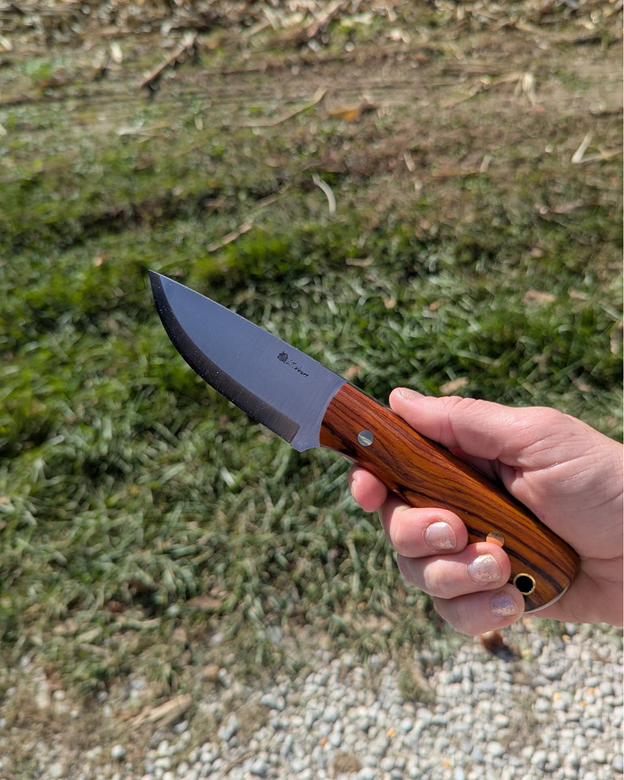
There are several good blade profiles for a bushcraft knife. Among the most popular of these are spear point, drop point, straight-back profiles, and to a lesser degree, sheepsfoot knives.
Spear point knives are popular because the point is symmetrical, meaning that you can use the point to drill holes in wood. The point of a spear point is also somewhat robust, which is also effective at resisting damage arising from hard use.
The same goes for drop point and straight-back profiles, which also sport relatively tough tips. Profiles like needle points and clip points are relatively unpopular as bushcraft knives because they have fragile tips.
Sheepsfoot blades are not particularly popular as bushcraft knives, but it’s worth the observation that what you lack in penetration power you get back in the stoutness of the tip. Plus, bushcraft knives are used for carving, chopping, and draw cuts more commonly than they are used for piercing.
Grind
Flat and Scandi grinds are the most popular grinds for bushcraft knives because they are robust grinds that result in an edge that is relatively easy to restore when the knife gets dull.
Convex grinds, though rarer than the former two, are also popular because they produce a very robust edge that is likely to chip or roll.
The only grind you should avoid in a bushcraft knife is a blade with a hollow grind, for two reasons. A hollow grind produces a fine edge that, though sharp, will dull quickly and will be prone to rolling and other damage. The other is that hollow ground blades don’t interact well with wood and tend to bite too deep. Save the hollow grind for the hunting knife and stick with a flat, Scandi or convex ground blade for bushcraft.
Sheath
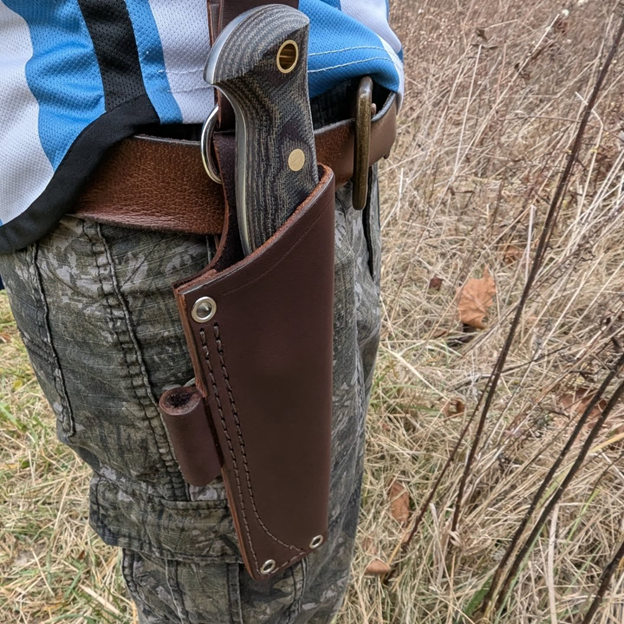
There is no “best” sheath for a bushcraft knife, but your main two options are going to be leather and thermoplastic.
A leather knife sheath will be more comfortable and more aesthetically pleasing, but leather traps moisture and can accelerate rust. It will also rot or crack if not properly cared for.
As for thermoplastic sheaths, despite the fact that they are not as comfortable, they offer solid retention, can be mounted various ways, which increases flexibility, they will not rot, don’t hold moisture, and never need any maintenance.
If low-maintenance is a must for you, stick with a thermoplastic sheath.
Knife Handle Scale Material
Knife handle scale material is another thing to consider in a bushcraft knife. While there are knives made with natural materials like bone, horn, antler, stacked leather and wood, and these materials are attractive, without proper care and cleaning they can rot or crack. This does not mean that a bushcraft knife should not be made with them; just that you should be aware that they will require more maintenance.
Knives that have steel, brass, or other metal alloy scales can be effective as bushcraft knives, with this caveat; it is dangerous to allow skin to contact metal at temperatures below 0℉, so always wear gloves if you do. Also keep in mind that knives with metal scales will be heavy.
All in all, most bushcraft knives are made with high-performance synthetic knife handle scales, most commonly G10, micarta, carbon fiber, or some other synthetic like glass-filled nylon. Overall, these are relatively lightweight, afford excellent traction even when wet and cold, and will never require any maintenance. They offer some of the best value for bushcraft knife scales.
Other Features
Some other features you should look for in a bushcraft knife include:
- A handle or pommel design with a pass-through that will allow you to attach a lanyard.
- Whether or not the sheath can be expanded with a ferro rod fire starter.
- Handle scales that have a bow drill divot for use with a bow drill spindle.
- Whether or not the steel is coated or finished to protect against corrosion, if the alloy is non-stainless.
- If the spine of the knife is squared, since a squared spine can be used to scrape tinder, flesh a hide, or used with a ferro rod to start a fire.
Explore Bushcraft Knives Here at The Knife Connection
Hopefully you found this guide helpful in picking out a new bushcraft knife, but if you still have questions about what to look for, get in touch with us directly and we will be more than happy to help.