 FREE USA SHIPPING over $99

Starting a Fire with a Survival Knife
Feb 3 2026 - 6:01
There are numerous ways to use survival knives as a supporting tool to help you build a fire in the woods.
Many of these are friction fire methods in which the knife is used to prepare wood for use in a hand drill, bow drill, fire plow, or some other method.
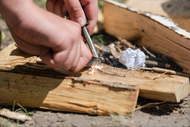
There is one method in which the survival knife is directly used to shave sparks off a fire steel, also known as a ferrocerium rod or ferro rod, to start the fire.
It requires much less skill and a smaller learning curve than many other primitive firecraft methods. Here’s your basic guide on how to do it.
Which Survival Knives Will Work (and Won’t)
First, you need to make sure you have an appropriate survival knife for the job. Pretty much any knife pattern will do, but there are a few things to observe here.
One (and this should be obvious) do not use the edge of your knife to strike the fire steel. It will work, but it will also do terrible damage to your edge.
The other is that you need a knife with a sharp spine, around 90° or so. A square spine is necessary to dig into the steel to shave off sparks.
Also, some survival knives with coatings on the blade are not well suited for this task. For example, the powder coating of many ESEE knives makes it almost impossible to use the spine to strike sparks from a ferro rod.
Otherwise, any survival knife will do.
Gathering What You Need
To strike a fire from a fire steel and a survival knife, you will need those two items, so that’s step one.
You will also need tinder. There are many sources you can use; ferrocerium sparks burn hot and will ignite a wide range of tinder sources much more easily than sparks from a real flint.
Some good sources of tinder include:
- Dryer lint or lint from your clothing
- Dead, dry grass
- Fine wood shavings
- Bark scrapings
- Char cloth
- Thistle down, dandelion down, milkweed down, and other fluffy plant material
- Cotton balls
- Cattail fluff
- Animal nests (which are made of dry grasses)
You will want plenty of tinder; gather about a fistful.
You will also want kindling, which is wood about as thick as a finger, if not a little thinner. You will want an armful of this.
Then you will want fuel, which are logs about wrist thickness, if not a little thinner. How much of this you will need depends on how big of a fire you intend to build.
Preparing the Tinder Ball
Once you have gathered an appropriate amount of tinder, you will want to build a small structure around it with some of your kindling.
Two common methods of fire-building are the teepee and log cabin method. If using the teepee method, construct your teepee and leave it open on one side so you can place the tinder in the center.
If using the log cabin method, leave it wide open at the top so you can strike the sparks down into it. Make sure you leave some kindling aside so you can strategically place it once you’ve lit the ball of tinder.
Striking the Sparks
Once you’ve arranged your fire, place your ferrocerium rod so that it is a few inches away from the tinder ball.
Take your survival knife with your dominant hand and lay the spine against the ferro rod at approximately a 45° angle. The base of the spine should be very close to the ferro rod.
Using moderate pressure, scrape the spine of the knife along the fire steel, down towards your ball of tinder. A shower of sparks should come off of the rod; if you’re not getting enough sparks, you need to press harder.
Don’t be too aggressive, though; if you’re too forceful with your motion and your hand holding the knife comes in contact with the teepee or log cabin, you can knock it over.
It should only take a spark or two to ignite the tinder, assuming it is of good quality and dry. Once it lights, start building the fire up.
Tending the Fire
If you’ve only used one fistful of tinder, you’ll have only a few seconds after it lights to start strategically placing more kindling around the fire so that it lights up.
Once the tinder is lit, if you used a teepee, take some more tinder and use it to close in the open face of the structure, being careful so as not to disrupt it.
If you used a log cabin, take some of your kindling and use that to create a “roof” on the structure.
In both cases, this will trap the heat from the tinder ball as it burns, helping the kindling to catch so you can really build the fire.
Once your structure’s lit, feed the fire as needed.
And that’s how you can use survival knives to strike a fire from a firesteel.
Explore Survival Knives and Ferro Rods Here
Looking for survival knives that are better suited to striking sparks from a ferro rod than whatever you’re using now? You’re in the right place.
Check out our collection of survival knives and fire starters and if you have any questions, get in touch with us.