 FREE USA SHIPPING over $99

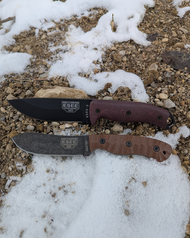
ESEE Knife Steel: About 1095
Jan 28 2026 - 2:06
If we had to pick three things that define ESEE as a brand, they would be the company’s legendary warranty (which follows the knife for life and guarantees it against breakage or other failure, even when caused by abuse), the use of its colorful powder coatings on its 1095 steel, and the 1095 steel itself.
Granted, not all ESEE knives are forged from 1095, and there are some select models made with S35VN, A2 and MagnaCut, among others. But the vast majority of ESEE models, including most of the ESEE 3, 4, 5, 6, Junglas, Izula, and Candiru lines, are made with 1095.
It is a solid tool steel, and a reasonably cost-effective one that offers very solid performance as long as you are aware of what its strengths and weaknesses are. This post will demystify that for you.
1095 and Its Metallurgy
The 1095 steel that ESEE knives utilize is far from proprietary. It is a well-known and widely disseminated tool steel from which knives and other bladed tools are commonly made.
This is a fairly simple tool steel, chemically, the main two constituents of which are iron (at between 98.38% and 98.8%) and carbon at between .9% and 1.03%. Typically 1095 has .95% carbon, which is where it gets its name, which it shares in common with other steels in the 10XX class.
This is a relatively high carbon concentration for a tool steel, and considerably higher than 1045, 1055 and 1065 (which have roughly .45%, .55% and .65% carbon in their matrices, respectively) the chief benefit of which is that this steel can be heat-treated to a relatively high hardness without becoming too brittle.
The higher the carbon concentration in the alloy, the better the steel can form a latticed, crystal structure that not only makes it stronger but harder, enabling it to maintain an edge for longer. This here is the chief attribute of this steel.
Carbon also forms carbides with key elements, although that is not a main fixture in 1095, which is relatively low in carbide-forming additives.
In addition to iron and carbon, the remainder of 1095 steel is composed of sulfur, at less than .05%, phosphorus, at less than .04%, and manganese, at between .3% and .5%. In terms of performance, you really don’t need to worry about the sulfur and phosphorus as they are present only in trace amounts and don’t really confer any material benefits to the steel.
As for manganese, it is the only significant chemical element included in 1095 other than iron and carbon in any significant amount, and it does offer a few beneficial attributes.
In small concentrations, manganese can improve the formability of steel, which is critical during forging, and it also makes the steel slightly tougher and stronger. This helps to temper and even out the brittleness that sometimes comes from a carbon concentration that is too high. Otherwise, manganese is pretty poor at forming carbides, so its main benefits come in the form of steel that is slightly stronger and more shock-resistant.
As for hardness, that is a matter not just of steel chemistry, but of heat treatment. ESEE knives are routinely heat treated to a Rockwell Hardness of 55-57, which we will explore in greater detail in the following section.
Physical and Chemical Attributes of 1095 Steel
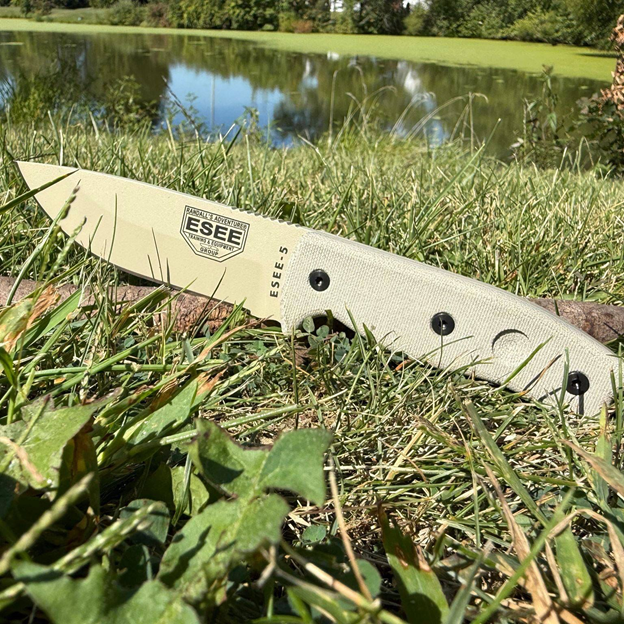
Now that we have put the chemistry of 1095 steel under a microscope (as well as the hardness of the steel used), we can unpack what to expect from the steel used in ESEE knives in terms of performance.
In terms of hardness, ESEE knives are in the middle of the road. ESEE itself warns you not to throw its knives as they will be likely to break, but on the same hand, most people that have actually carried and used ESEE knives will say the steel is downright soft. You can get a razor sharp edge on an ESEE, but after a day of hard use that edge will definitely have softened up a bit and need to be retouched.
But the softness of the steel is not necessarily a bad thing; unlike modern super steels that are rich in carbide-forming elements like vanadium (and which are extremely hard) the 1095 used in ESEE knives is very easy to resharpen, even in the field, with nothing more than a single-grit knife sharpener or pocket stone.
As for toughness, the 1095 that ESEE uses is pretty good. It’s actually not as brittle as they’d have you believe, and (to reiterate) while you definitely shouldn’t throw your ESEE knives, they’re more than tough enough to use for chopping or batoning. You shouldn’t twist or pry with them either, but honestly they’re tough enough to take it. And, if you break the knife, ESEE will replace it. We’re not advocating for knife abuse, just calling a spade a spade.
Lastly, and this is an important note, is that 1095 is a rust magnet. Without any sort of corrosion resistant additive (1095 lacks both chromium and nickel, which are the two metals most commonly added to make a steel “stainless”) you can fully expect your ESEE to rust if you are not careful.
Which is precisely the reason that ESEE powder-coats its 1095 knives - and that’s most of them. The portion of the blade that’s powder coated will be fine so long as you have not worn off the finish; but the edge and “ESEE” logo (on applicable knives) will rust right away.
So, two notes for you: do not use a 1095 ESEE knife in a marine environment (you will regret it) and never put your ESEE away wet. After you use it, clean it, dry it off, and oil it, and you will be better prepared to fight back against the inevitability of rust.
Explore ESEE Knives Here and Add to Your Collection Today
Now that you know what to expect from the 1095 steel used in most ESEE knives, you’ll be better prepared to use the knife more effectively as well as to care for it. Shop our collection and get in touch with us if you have any questions.