 FREE USA SHIPPING over $99

Finding the Best Tactical Knife for You: What to Look for
Aug 27 2026 - 1:02
Finding the best tactical knife is like finding the best survival knife or camp knife. There are many different styles of knives out there and not every single pattern is the best pick for any given person.
Therefore, finding the best tactical knife for you is really a matter of analyzing the features to determine whether or not they will perform well for your intended use. That being said, here are a few things to consider when shopping.
Blade Steel
The blade steel of the best tactical knife should offer some balance of good edge retention, general toughness, and resistance to corrosion.
There is no single best alloy for a tactical knife, but some good ones are:
- 1095 (or anything else in the 10XX class)
- AUS 10
- VG10
- 8Cr13MoV
- D2 (and other similar tool steels)
- S30V
- S45VN
- MagnaCut
- M390
- 14C28N
This is by no means comprehensive but it is a good place to start. There are other good knife steel alloys out there besides these, but the ones mentioned, as a general rule, offer a good deal of performance with respect to the three attributes mentioned.
Blade Profile
The blade profile of the knife will also impact its performance and suitability as a tactical knife. If you are looking for solid all-around performance with a straight tip that is relatively robust, then straight back, drop point, and spear tip knives work well. A tanto point also is one of the best tactical knife profiles if you need a strong point that will still penetrate well.
If you need an even more robust tip, a good option is a sheepsfoot, although that will come at the cost of poorer ability to penetrate a target.
On the other end of the spectrum, if you want a profile that is well-suited to penetrating, clip points and needle points will perform well, but they will have more fragile tips.
Straight Edge or Partial Serrations?
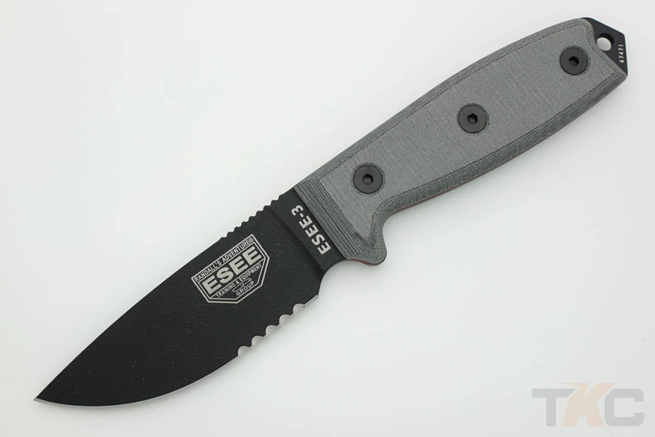
A tactical knife will have either a straight edge, a fully-serrated edge (though this is less common) or else it will have a combination edge that is partially serrated.
While a straight edge will be good for general purpose utility, it will not be as efficient at cutting through hard or tough materials like bone, plastic, wood or cordage, or some textiles. Partially serrations in the edge give you greater flexibility to dispatch materials like these.
Crossguard or No Crossguard?
Many tactical knives are made with crossguards in front of the blade which aid in control and which help prevent the user’s hand from slipping up over the blade when in use.
Others have deep choils, or even sub hilts, which are basically a second crossguard that protrudes from the handle and which sits between the user’s index and middle finder.
Both choils and sub hilts also aid in control, and they specifically can be used for leverage when thrusting with the knife or when withdrawing it from a target.
Blade Coating
Many of the best tactical knives are treated with specialized blade coatings which can offer a number of different benefits.
For one, some blade coatings, like the powder coatings of ESEE knives, or the PVD coatings of other tactical knives, can insulate the blade, protecting against corrosion.
If the blade coating is bright, it can aid in visibility, helping to prevent you from losing the knife should you ever place it down.
Also, some coatings, depending on the finish, reduce the reflectivity of the blade, making it less noticeable in bright light, enhancing discretion and supporting concealment.
Full-Tang Construction
Not all tactical knives sport full-tang construction, but the best of them do because full-tang construction lends the highest strength possible to the knife and minimizes the risk of breakage.
Handle Scales
Even though natural scales are pretty, the best tactical knife will have high-quality synthetic or else alloy scales. Synthetics like carbon fiber, GFN, G10, or Micarta, or else alloy scales of steel or titanium. These are lower in maintenance requirements and physically more durable than even the best natural scales. Some tactical knives even have scales that feature aggressive texturing so as to afford a sure grip even when the knife is wet or greasy, or when your hands are cold.
Sheath Material, Features and Configuration
A leather knife sheath may be pretty (and comfortable) but as a general rule the best tactical knife will have a Kydex sheath that will offer flexibility when it comes to how you rig and carry the knife.
Kydex sheaths (and other synthetic knife sheaths) are also lower in maintenance requirements than leather knife sheaths which gives them another edge.
Other Features
When looking for the best tactical knife you should consider other features such as:
- A differential grind that can be used for different cutting tasks.
- Whether or not there is a lanyard hole.
- If there is an exposed pommel or glass breaker.
- If the spine is square, which can be useful for throwing sparks off a fire starter.
These are just a few of the things you should also be looking for but they can lend value to a tactical knife.
The Best Tactical Knife for You Is Here, You Just Need to Find It
Not sure where to start? The best tactical knife for you is here. You just need to find it. Start by looking through our collection of tactical knives and if you have any questions, get in touch with us for more information and we will be happy to assist.