 FREE USA SHIPPING over $99

How to Maintain the Leather Handles on KA-BAR Knives
Oct 8 2026 - 11:50
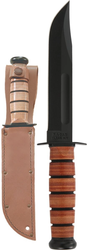
One of the unique features of classic KA-BAR Knives is that they sport knife handles that are rare nowadays. Notably, they are made with stacked leather handles.
While today most survival and camp knives are outfitted with either G10, Micarta or wooden knife handle scales, some knives, such as many KA-BAR Knives, are outfitted with stacked leather handles which consist of stacked hollow leather rings that allow the tang to pass through them.
They are softer than conventional knife scales, and more comfortable in the grip. They’re also safer in extremely cold temperatures because they won’t cause skin to freeze immediately, like exposed steel can.
Stacked leather knife handle scales also offer better traction in wet conditions as the leather has a little tooth and is softer, affording better purchase and control than many other smooth knife handle scales like smooth bone, wood, or even phenolic.
However, stacked leather handle scales, just like a leather knife sheath, will require a little bit of extra care and maintenance to ensure they last. Here’s what you need to know.
Stacked Leather Knife Handle Maintenance: Cleaning and Conditioning
While stacked leather knife handles will offer excellent traction and grip even under adverse conditions and in wet weather and cold temperatures, if you neglect them for too long, they will deteriorate.
Leather is a natural material, which it shares in common with other knife handle scale materials like wood, bone, and horn. However, leather, unlike these, is a lot more fragile.
And, unlike synthetic knife handle scales like Micarta and G10, leather is highly absorbent. Some stacked leather handles are sealed to help minimize moisture intrusion, but they’re still more susceptible to it than these other synthetics.
So, the first thing you want to make sure of is that if you have a knife with a stacked leather handle, like a KA-BAR knife, you protect it from water, blood, grease, and other moisture. And, if the handle does come in contact with these liquids and absorbs them, you need to make sure that you dry it out relatively quickly.
That is, if your knife handle gets saturated with any liquid, you need to keep it in a cool, dry place with good ventilation until it dries out. Don’t leave it at the bottom of a pack or stuff it in a drawer or closed compartment with no airflow.
How frequently the knife handle needs to be cleaned will depend in part on if any sort of sealant has been applied to the stacked leather, and if it is in good condition. If the leather is bare or mostly bare, you will want to clean the handle scales whenever they darken or show an accumulation of dirt.
For most intents and purposes you can use a leather cleaner like saddle soap for this. Apply it as instructed by the manufacturer, and as needed.
Leather also will need to be periodically conditioned in addition to needing to be cleaned. Without proper conditioning, leather will be much more susceptible to water damage, delamination, warping, cracking, and dry rot.
A good rule of thumb is to condition the stacked leather handles at least once every 6 months, but more frequent conditioning may be needed if the leather shows signs of dry rot or other damage.
To condition leather, work a small amount of conditioner into the outer surface using a sponge or clean cloth. There are commercial leather conditioners you can use, such as Mink Oil, but you can also use neatsfoot oil, beeswax, or a combination of these.
Proper use of a knife with stacked leather handles is also routine care. In this instance, it is important that you never submerge your knife in water if you can help it. If so you will need to make sure you dry it out quickly enough that you don’t allow mold, mildew or other types of rot to form, but not so quickly that the leather cracks.
You also want to avoid putting your knife in the dishwasher, but this is something that should go without saying; even kitchen knives should not be run through the dishwasher as the harsh detergents and high heat cycles can damage both the blade stock and the scales.
As for storage, it is best if you don’t store the knife in its leather knife sheath for a prolonged period of time as that can encourage rust to form on the blade. You should also make sure you store the knife and its sheath in a cool, dry place with plenty of airflow.
All in all, if you keep to these tips and suggestions, your KA-BAR knives, or any other knives with stacked leather handles, should have no issues.
Shop KA-BAR Knives
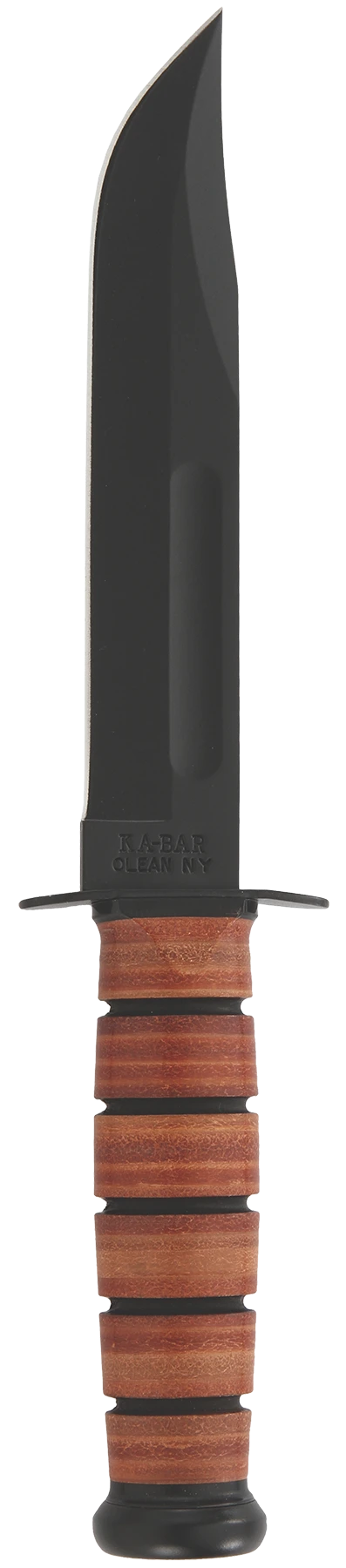
In the market for a new knife with classic appeal and features, like stacked leather scales and a leather knife sheath? Check out our collection of KA-BAR Knives and other knives like Ontario Knife Company models that sport the same features. Explore our collections and if you have any questions about anything we sell before you buy, get in touch with us and we will be more than happy to help.