 FREE USA SHIPPING over $99

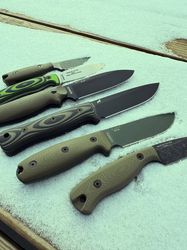
Survival Knives vs. Camp Knives vs. Hunting Knives: Knowing the Difference
Jul 20 2026 - 1:54
In this industry, lots of terms get thrown around, some of which don’t mean very much without context. Tactical, stainless, and so on and so forth.
But some terms have some connotations associated with them, and others are more concrete. This post will investigate three basic categories of knives, camp knives, hunting knives and survival knives, and what the soft (and in some cases, concrete) differences are between them.
Survival Knives
First let’s take a closer look at survival knives. Ultimately, a survival knife is any knife that’s intended to be an indispensable tool in the field if you have no other recourse or help. For this reason, most survival knives have a lot of versatile features.
Survival knives are intended to be able to assist with, or entirely handle, a wide variety of tasks, including but not limited to constructing camp furniture and shelters, making fires, making traps and cleaning harvests, and much more.
For these reasons, a survival knife should be a fixed blade knife with a full tang and feature robust construction as it is reasonable to assume it will be abused at some point or other. Even if it is not it should still be able to stand up to hard use.
There is no set size for a survival knife, but most will have blades between 3 and 6 inches, making them relatively compact, while some are in the middle of the road in terms of size and weight, which makes it easier to carry them or pack them in survival kits.
Some survival knives have features like serrations on the spine that makes them more effective for cutting cordage, wood, bone and other materials that would turn a straight edge, as well as bow drill divots in the handle scales.
Survival knives also tend to have scales that are made from synthetic materials that will need minimal maintenance, improving their serviceability in the field.
Camp Knives
The term camp knife has a more concrete meaning than survival knife. Camp knives are generally large fixed blades with full tangs, like survival knives, but they are even larger and sport even more robust construction.
Think of a camp knife as one step smaller than a machete, but otherwise specialized for many of the same uses, such as clearing brush and maintaining trails, chopping and batoning wood, processing small trees, and constructing camp furniture.
A camp knife will customarily have a blade longer than 8 inches, and many camp knives have 10 or even 12 inch blades, or larger, again, bordering on the territory of what would conventionally be considered a machete.
Many camp knives sport comfortable, ergonomic handles made from modern synthetics like G10 and Micarta that are low-maintenance, but some are also made with wood or other materials. Also, high-carbon, non-stainless blades are not uncommon among camp knives. Alloys like 1045 and 1095 are common; though they don’t resist rust, they are able to tolerate abuse that some other harder, more brittle alloys cannot.
Hunting Knives
Lastly, let’s take a closer look at hunting knives. This is the least-defined of the categories here since any knife you carry with you hunting can be considered a hunting knife, and moreover, there is no single pattern or profile that is universally considered a hunting knife.
Hunting knives also can be fixed or folding, though most would likely think of a fixed blade when prompted by the term “hunting knife”. Patterns that are commonly carried by outdoorsmen include skinners (and Muk knives), capers, boning knives, and filet knives. Knives with clip-point blades, drop points, and straight back profiles, like Mora and Martiini knives, are also commonly considered hunting knives.
Hunting knives typically sport a full tang, but in some cases a stick tang is tolerable, since hunting knives are designed for processing harvests, not for chopping wood or executing other grueling tasks. Scale materials may be synthetic, but natural materials such as wood, horn, antler and bone are common on hunting knives for aesthetic purposes.
While it is not an absolute necessity that a hunting knife be made with a stainless blade, it is common, because hunting knives often encounter moisture and corrosive influences as a result of their intended use. If you have a hunting knife with a non-stainless blade, you’ll just need to take more care to keep it clean and dry after use.
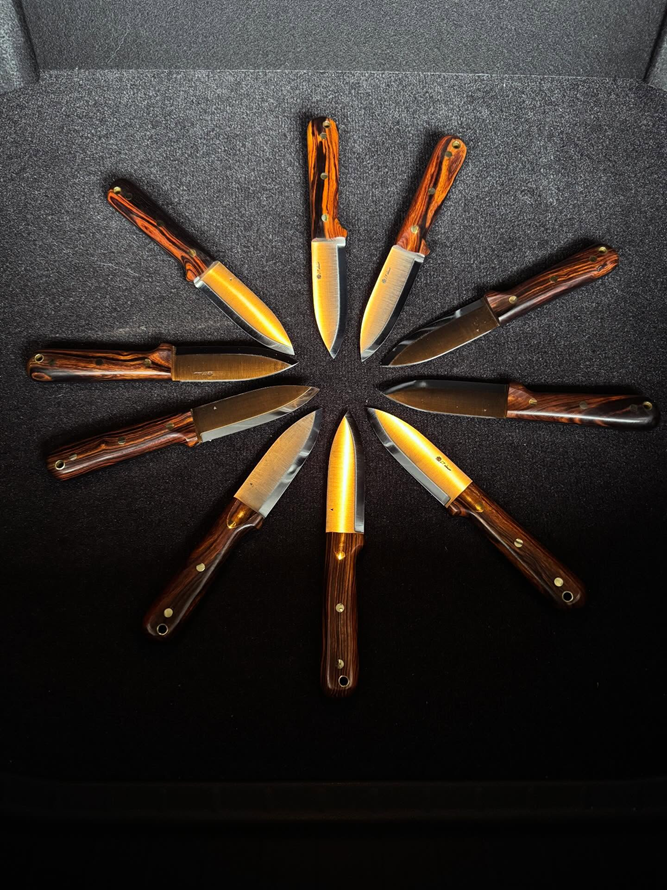
Explore Camp, Hunting and Survival Knives at The Knife Connection
Hopefully you found this guide helpful, and have a slightly better understanding of what’s meant by camp knife, survival knife and hunting knife even if the terms remain somewhat nebulous.
Shop our collection which represents the top brands in the industry and if you have any questions about anything before you buy, get in touch with us and we will be more than happy to help.