 FREE USA SHIPPING over $99

8 of the Best Tactical Knife Carry Methods
Mar 24 2026 - 1:44
How you carry a tactical knife, whether for duty, or for personal use, should be determined by both your needs and preferences. For instance, if a high-degree of concealment is needed, neck carry is a solid choice. If you need quick access to a larger blade, maybe dangle or scout or pack carry is the best option.
Regardless, this post will cover 8 of the best tactical knife carry methods.
Belt Carry, Tip Down
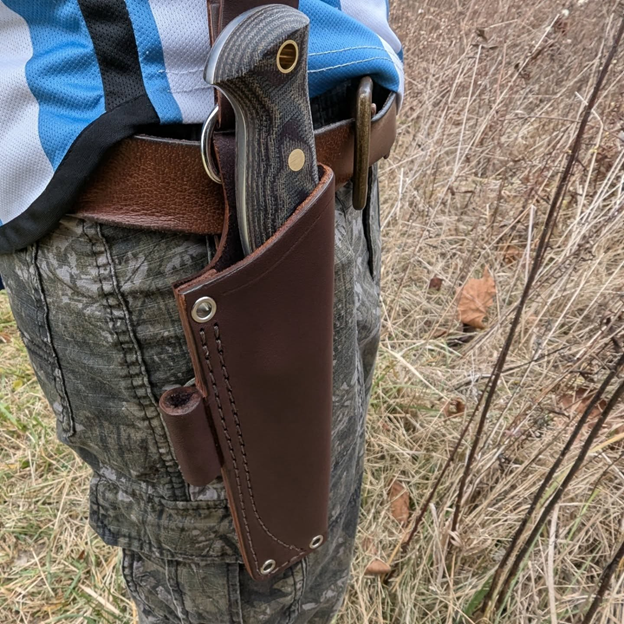
This is everyman’s carry method and certainly is not restricted to tactical knife carry. Hunters and other outdoorsmen overwhelmingly carry tip down on the belt, on the dominant side.
It is also by far the most common carry method and for that reason most knife sheaths are inherently designed to be carried tip down on a belt.
It offers easy access and for the most part the knife should carry out of the way. Two things to keep in mind is that belt carry doesn’t offer good concealment and it’s not comfortable with a larger belt.
Belt Carry, Tip Up
The benefits of tip-up belt carry are effectively the same as those of tip-down belt carry. However, due to the fact that the knife will be carried inverted, it’s really only practical with fairly small knives.
Also, you need a sheath that offers a friction fit and allows for inverted mounting, otherwise you run the risk of the knife dropping out.
Dangle Carry
While not that common as a tactical knife carry method, dangle carry, also known as drop leg carry, is one of the best tactical knife carry methods for knives with larger blades.
This is because the sheath usually attaches to a belt loop via a D-ring, allowing the knife and sheath to swing completely freely of your belt when you’re carrying. It also prevents larger blades from “poking” you in the leg when you kneel, stoop, bend over, or sit down.
However, you generally need two hands to draw and re-sheath a knife carried in this manner.
Neck Carry
Neck carry is one of the best tactical knife carry methods when concealment is the biggest concern, as you can wear smaller neck knives under your clothes, while still having pretty ready access.
Neck carry is best when done with a small knife with a thin profile so as to prevent printing. For one-handed access, you also need to carry the knife tip-up with a sheath that offers a friction fit.
However, re-sheathing a neck knife generally requires the use of both hands. On top of that, it’s best if you wear a breakaway cord to prevent the cord being a safety liability, since it will be worn around your neck.
Boot Carry
The main advantage of boot carry, like neck carry, is the discretion, and it’s unlikely you’ll be suspected of carrying a knife in your boot.
Also, a boot knife can also generally be drawn and re-sheathed with one hand, which is a bonus.
There are, however, some caveats to enumerate here. One is that you will be limited in terms of the tactical knife you can carry by the size of your boot, and how the sheath is secured.
The other is that it is hard to access boot knives from unnatural positions, so access can be complicated in some situations. However, a boot knife can be great as a backup tactical knife.
Scout Carry
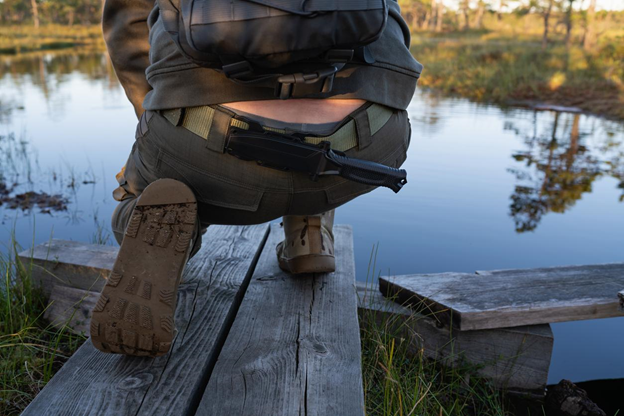
Scout carry is an increasingly popular carry method, and the way the knife is oriented along your belt at the base of your lower back makes it suitable not just for small knives but for larger blades, too.
In fact, this is one of the best tactical knife carry methods for larger blades because it will keep the length of the blade out of your way, even when you are sitting down. Access and reach are also intuitive with scout carry, though some users find it is easier to re-sheath the knife with two hands.
It’s also reasonably good for concealment. The one concern here is that it can be hard to access a knife that’s scout carried if your back is pressed against a wall.
Pack Carry
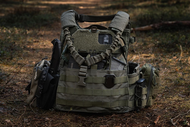
Pack carry is a great option if you like a knife that’s too large to carry comfortably on your person, or if the gear you carry makes it hard to access the points where you’d normally carry a knife, such as your neck, belt, or lower back.
To pack carry, you need a sheath that can be clipped or lashed to your pack. Perforated, MOLLE-compatible Kydex sheaths are perfect for this, and they can be rigged any way you want, either on the back of the pack or at the base.
Another popular place to lash a pack-carried knife is on the non-dominant shoulder strap, so it can easily be accessed by the dominant hand.
While pack carry can still offer solid access, one potential drawback is that if you remove the pack you will be separated from your knife.
Static Line Carry
Static line carry requires a fairly small knife as well as a sheath that has a hole, generally at the tip. You secure a line to the tip of the sheath and somewhere on your person, and as you pull the knife by the handle away from your body, it will pop out of the sheath, while the sheath still remains tethered to you.
Static line carry can be practiced according to numerous disciplines, but it is most commonly practiced with small tactical knives that fit inside a pocket, improving access, concealment, and retention of the sheath when the knife is drawn swiftly.
Pick Up a New Knife Here Today
While these are some of the best tactical knife carry methods available to you, this list is in no manner comprehensive.