 FREE USA SHIPPING over $99

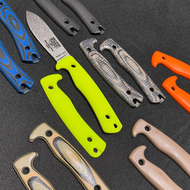
Knife Scale Materials: Spotlighting Micarta and G10
May 25 2026 - 7:54
Two of the most popular synthetic materials currently used to make knife handle scales, both mass-marketed and custom knife scales, are Micarta and G10. Both of these synthetics are excellent for that application and are well-suited to such a purpose. This post will take a closer look at each of them.
What Is Micarta?
In case you’re wondering why Micarta is always curiously capitalized, it’s because it’s a brand name, technically not a generic name for a material, although it is commonly used that way.
What’s more important, though, is what Micarta actually is. It has become a collective term for a type of composite that is made from one of many different sorts of fibers that are solidified using a thermosetting plastic.
Fibers commonly used include paper, linen, burlap, canvas, cork, other cotton fabrics, fiberglass, and carbon fiber, though other materials can be used. The fibers are then impregnated with a thermosetting plastic, such as phenolic or epoxy resin, though silicone can also be used.
Once the fibers themselves are impregnated, they are heated and pressurized, causing them to absorb the resin and then to polymerize, forming into a stable, strong, laminate material.
The resulting material is a laminate that preserves many of the virtues of the constituent fibers, but in a significantly stabilized format.
Because Micarta can be made from a wide variety of different fibrous materials, it can sport a wide range of aesthetics and colors, which makes it very popular not just for its material and physical properties, but for its visual allure, which makes the material popular for making custom knife scales.
What Is G10?
All things considered, G10 is actually remarkably similar to Micarta. Basically, G10 is a fiberglass laminate; like Micarta, it is a composite, except in this case it is made of fiberglass that has been impregnated with an epoxy resin, then heated and pressurized, like Micarta, until it cures.
Basically, the only real difference between them is that G10 obligatorily uses fiberglass cloth as the filler material, whereas other fibers may be used in the manufacture of the former. It has often been observed that G10 is the toughest, and one of the densest of these types of materials, making it one of the most commonly used.
Like Micarta, G10 can also be made with fiberglass of a wide range of colors, so G10 can also be used to produce a very specific desired aesthetic in handle scales for knives.
Why Are G10 and Micarta Knife Handle Scales Popular?
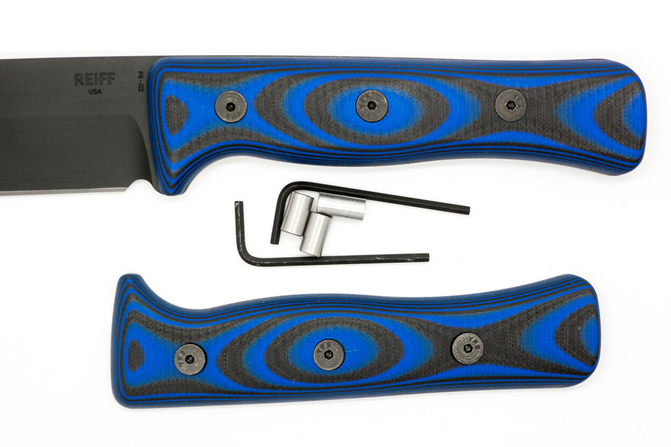
In case you haven’t noticed yet, there is more in common between Micarta and G10 than there is different. For this reason, pretty much all of the virtues each has as a knife scale material, they share in common. So let’s take a closer look at why both of these synthetics are commonly used to produce knife handle scales.
First, both Micarta and G10 can be produced to have a pleasant, almost soft, for lack of a better word “warm” feel in the hand. This is because the texture of the textiles from which they are made often telegraphs through the knife scale material. For instance, a knife with canvas Micarta scales will almost feel like it has a handle wrapped in canvas cloth - although it’s not quite that simple.
This gives them excellent traction, but it also makes them safer in extreme cold conditions wherein it would be dangerous for naked skin to come into contact with exposed metal alloys. This property also makes them popular for making handle scales for knives.
The traction offered by these materials does not diminish when the scales are wet, and in fact, even though they will be more slippery covered in grease, they retain some of their tactile aesthetics.
Moreover, neither Micarta nor G10 knife handles will absorb liquids, so whether you slather them in water, oil, grease, blood, or something even worse, all you have to do at the end of it is rinse them off. They won’t soak it up.
That’s another thing. Both Micarta and G10 are impressively chemically stable. This means they will not rot or decay, and will not allow mold or mildew to grow on them. They are basically maintenance free, putting them a whole tier above natural materials like wood, bone, antler or horn. Nothing against these natural materials, which are good in their own right; it’s just that by contrast neither Micarta nor G10 will need any cleaning or maintenance.
There are other reasons that these materials are popular for knife scales, but this covers some of the big selling points, and the case has been sufficiently made.
Explore Custom Knife Scales Here
We carry a wide range of survival, bushcraft, survival and camp knives made with Micarta and G10 scales, along with other synthetic materials like Richlite and carbon fiber. Naturally, many of the knives we carry are also made with natural scale materials. There is no shortage of options here.
In addition, we also carry a number of aftermarket handle scales for knives, like Becker and ESEE Knives. Explore these in our collection here and if you have any questions about compatibility or installation, get in touch with us directly and we will help.