 FREE USA SHIPPING over $99

Pocket Knives and Lock Types: What to Know
Mar 23 2026 - 1:40
Back when Buck released its 110 Folding Hunter, there weren’t too many types of pocket knife lock types commonly available on the market. Now the industry is awash with new lock types, and pocket knives are being released with new lock types (or updated locks) every few years.
This is evident in the proliferation in button locks and bar-style locks, (like Benchmade’s AXIS lock) that has occurred in the industry in the last decade. It seems like every major brand has jumped on the bandwagon.
That being the case, it’s beneficial to know what the major differences are in common folding knife lock types, as well as what their relative virtues are. Here are some of the more common ones.
Slip Joint (No Lock)
The slip joint (or slipjoint) is only on here because it is common on traditional pocket knives. It is also not a lock, technically. A knife with a slipjoint mechanism has a spring tensioner bar that will hold the blade open and closed under tension, but will not lock it in place.
They’re good for carrying in areas where pocket knives with locks are forbidden, and a slip joint is also cost-effective to manufacture, so slipjoint knives tend to be fairly affordable.
Liner Locks
The liner lock is perhaps the most ubiquitous lock type on the market, all things considered. It consists of a piece of spring metal, usually integral with the liner (hence the name) which springs open under the bottom of the knife when it is deployed, wedging and locking the blade open.
Here are some things to know about liner locks:
- They are fairly affordable and simple to operate, so they are very common.
- They can be deployed and disengaged with one hand, however, your fingers will be in the path of the blade when closing so you must take care.
- The design inherently favors a right or left-handed user; most favor right-handed users.
- If abused, the liner can deform and bend, which will irreversibly damage the knife.
Frame Locks
A frame lock is basically the same as a liner lock, except the spring that swings inward is integral with the frame, not the liner. As a result, frame locks are much thicker and stronger than liner locks, but they have basically all the same features and benefits:
- They can also be deployed and disengaged with one hand but require you to put your fingers in the way of the blade when closing.
- The design inherently favors a left or right-handed user, usually a right-handed user.
- However, they are stronger and less prone to failure than liner locks.
Lock Back
The lock back, featured on the Buck 110 Folding Hunter which was revolutionary for its time, is one of the oldest lock types for pocket knives. It sports a bar along the back of the knife held under tension by a spring. When the blade is opened the bar locks into a notch in the blade; to disengage, the lock must be depressed to disengage it.
Here are some other notes:
- Lock backs can be deployed with one hand but usually take two to close.
- They’re not as ergonomic as other lock types and knives with them tend to be a little heavier.
- When closing a lock back, you can keep your fingers out of the path of the blade.
Button Lock
Button locks became really popular in the last few years or so, and while the design varies, the basic mechanism is either locked open or closed and engaged via a button.
Button locks have several advantages, such as that:
- They are easy and intuitive to operate.
- As a rule, they can be both engaged and disengaged with one hand.
- Button locks tend to be very strong.
- Button locks are difficult to accidentally disengage.
- When closing the blade, you can keep your fingers out of the way of the blade’s path.
That being said, button locks also favor right or left-handed users, typically right-handed ones.
Bar Lock (AKA AXIS Lock)
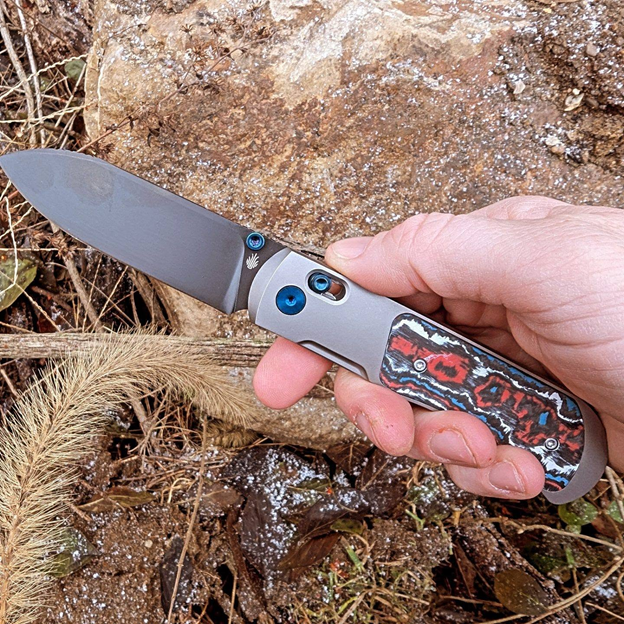
Bar locks, made famous by Benchmade, which pioneered them and called them AXIS Locks, consist of a cylindrical bar that rides between the knife handle scales. It moves backward and forward in a slot and is held open and closed under the tension of a U-shaped spring.
When the knife is opened, the bar moves forward and engages a corresponding divot in the blade. There are numerous advantages of bar locks:
- They are among the strongest, if not the strongest pocket knife locks on the market.
- They are very intuitive to use.
- The design is inherently right and left-handed friendly.
- The lock can be engaged or disengaged with one hand.
- It is almost impossible to accidentally disengage the lock.
All in all, bar-style locks are among the best locks on the market.
Explore Pocket Knives from the Top Brands at The Knife Connection
While this post isn’t a complete or comprehensive review of the types of locking mechanisms that are used with pocket knives, and there are others, like collar locks and compression locks, it does cover the major common ones.
Take a look through our collection to find something new today, and if you have any questions about any model, blade steel, lock type, or anything else like that, get in touch with us and we will be more than happy to help.