 FREE USA SHIPPING over $99

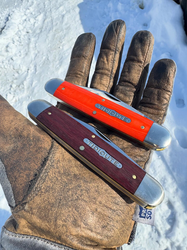
Traditional Pocket Knives: Patterns
Feb 24 2026 - 2:30
Traditional pocket knives tend to have between 1 to 4 blades and most lack locking mechanisms, instead having a slipjoint mechanism that holds the blade open (and closed) under tension. Most traditional patterns also don’t have special opening mechanisms or assists, instead relying on nail nicks. This means that most require two hands to open and close. The majority of traditional pocket knives are also fairly small and light, enough to fit into a vest pocket, whereas many modern pocket knives are much larger.
This short post will break down the details of some of the more common patterns among traditional pocket knives, such as those produced by Great Eastern Cutlery, Case, and Rough Ryder.
Types of Blade Profiles Common on Traditional Pocket Knives
Most but not all traditional pocket knife patterns are made with more than one blade. The following are the most common types.
- Clip point: A clip point has a very fine point with some of the blade stock removed from behind it (giving rise to the name). Clip points excel at detailed work.
- Spey point: Traditionally used to spey livestock (thus the name) a spey blade has a semi-blunted point.
- Sheepsfoot blade: A sheepsfoot blade has a spine that curves down to meet the edge, resulting in a fairly blunt tip that is very strong.
- Spear point: When a traditional pocket knife is outfitted with a spear pointed blade, it is referred to as a pen knife. This is a small blade that was traditionally used to sharpen quills (hence the name).
1-Blade Patterns
- Toothpick: A toothpick knife has a slightly curved handle and usually only a single, clip pointed blade with a light profile. These knives are somewhat fragile but good for general utility, such as light food prep.
- Swayback: A swayback knife tends to have a single, sheepsfoot or wharncliffe blade, and is good for purposes that require a somewhat stouter tip.
2-Blade Patterns
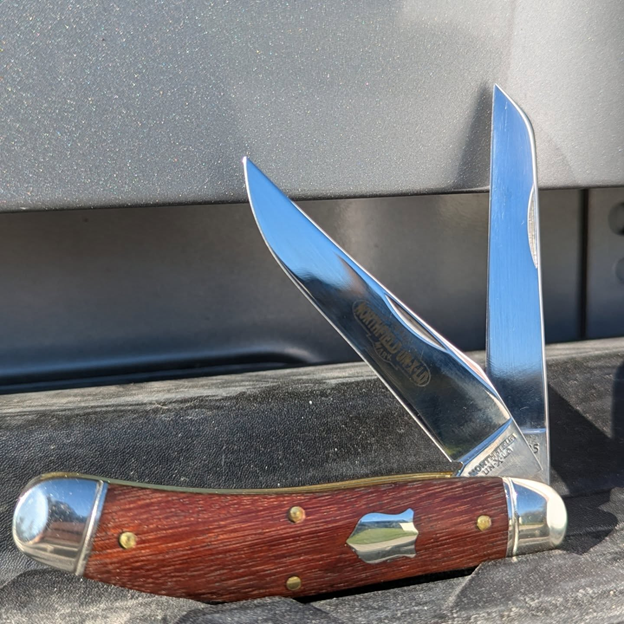
- Canoe: Canoe knives tend to have two spear point blades (AKA pen knives) one on either end of the knife. The blades are usually staggered in size.
- Barlow: A barlow knife is a pattern with a clip point and a smaller pen knife, both on one end of the knife, and with a single bolster.
- Trapper: Trapper knives have two blades on one end, a clip point and a spey blade. Usually they are of similar length, or the same length.
- Copperhead: Copperhead pattern knives have a clip point and a straight back blade, usually of the same length.
- Muskrat: A muskrat knife has two clip point blades, usually of the same length, one on either end of the knife, and two bolsters.
3-Blade Patterns
- Stockman: One of the most common of all traditional pocket knife patterns, a stockman knife has three blades; typically a clip point and a sheepsfoot on one end, and a spey blade on the other.
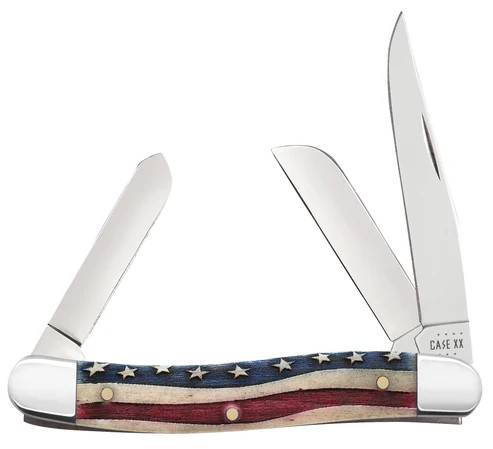
- Sowbelly: A sowbelly is effectively the same as a stockman knife, with the sole exception being the shape of the knife’s profile, which is more gracefully curved, and appears to hang like a “sow’s belly,” giving the name.
4-Blade Patterns
- Congress: Congress knives have two blades on both ends. Usually, both ends have both a sheepsfoot blade and a pen blade, commonly all four blades are of slightly different sizes and lengths.
FAQs
- What is a jackknife?
A jackknife, or jack knife, is any pattern of pocket knife that has two or more blades that pivot from the same side of the knife. It may have one or two bolsters. Therefore, a barlow and a trapper knife are both jack knives, but a muskrat knife is not. A stockman is also not a jackknife because all three blades do not share the same pivot point.
- How do I care for a traditional pocket knife?
Caring for a traditional pocket knife doesn’t have to be too involved, basically you want to keep it clean and protected against rust and corrosion.
After use, rinse and wipe off the blades. Make sure you allow the knife to dry fully before storing it. Never put a knife away wet or it may rust.
Both stainless and non-stainless blades will benefit from a light coat of oil that will protect them against corrosion.
Lightly oil pivot point as well. This will help keep the blades swinging freely and will insulate them against corrosion.
Periodically, use compressed air to blow out the space between the scales. This will loosen and remove lint and other debris that can cause abrasive damage and result in a gritty knife.
Keep the knife scales clean. Pay special attention to traditional pocket knives with natural scales like bone or horn, as these are more fragile and more likely to crack or break than metal alloys or modern synthetics like G10 or micarta.
Lastly, store your knives somewhere cool, dry, and out of direct sunlight. This will help protect them and keep them in good shape and free of rust and corrosion.
Explore Traditional Pocket Knives Here
In the market for a new traditional pocket knife? Check out our collection here and if you have questions or are looking for something specific, get in touch with us directly and we will be more than happy to help.