 FREE USA SHIPPING over $99

What Distinguishes Great Eastern Cutlery Knives
May 18 2026 - 3:41
Many modern folders are made with super steels like MagnaCut and S90V (among others) which offer an advanced level of corrosion resistance, not to mention next-level toughness and edge retention.
Some companies, like Great Eastern Cutlery, are committed to the use of more traditional materials (and patterns, for that matter).
You’d think a company that was only founded 20 years ago would be more into the modern hype, but GEC isn’t. With that said, here are 3 reasons why Great Eastern Cutlery knives should have a place in your collection, or better yet, why you should carry one.
Traditional Patterns
The vast majority of Great Eastern Cutlery knives are made in traditional, multi-blade folding pocket knife patterns. Some examples of patterns they produce are jack knives, whittlers, physician’s knives, and classics like 3-blade stockman knives.
These traditional patterns usually combine multiple different blade patterns, like clip points, sheepsfoot, and pen knives, along with specialized patterns like wharncliffe knives (sometimes also referred to as whittlers) into one package.
In other words, whereas with a modern fixed blade or folder, you only get one blade and one edge. With a traditional pattern pocket knife, you can carry multiple blades in one single tool, giving you a much greater overall deal of versatility.
Another note on these traditional pattern pocket knives is that the majority of them don’t have locking blades. They are mostly made with slipjoints, like most traditional folders, in which the blades are held open (or closed) via the action of a spring.
While some might find this inconvenient, for others it signifies an advantage, as non-locking traditional pocket knives can often be carried in public in places where locking knives are forbidden.
Blade Steel
The blade steel used in most Great Eastern Cutlery knives is far and away the biggest value proposition of the brand. But, you might wonder, what super steel do they use?
They do not. They use 1095 HC (for high carbon). This is, not to mince words, a very run-of-the-mill steel. It’s basically the same alloy most ESEE knives use.
Your next thought might be something along the lines of why these knives are so expensive or popular if they aren’t using super steels like the rest of the prime contenders in the knife industry.
Well, for that very reason. Simple alloys like 1095 just aren’t as popular now as they used to be. This tool steel was much more popular years ago than it is today, but the truth is it is still a good alloy.
With nearly a full percent of carbon in the matrix, with a proper heat treatment a 1095 blade can take and hold a very sharp edge while remaining fairly easy to sharpen. And, this is a proven alloy with respect to toughness, which is another selling point.
Quality Scale Materials and Construction
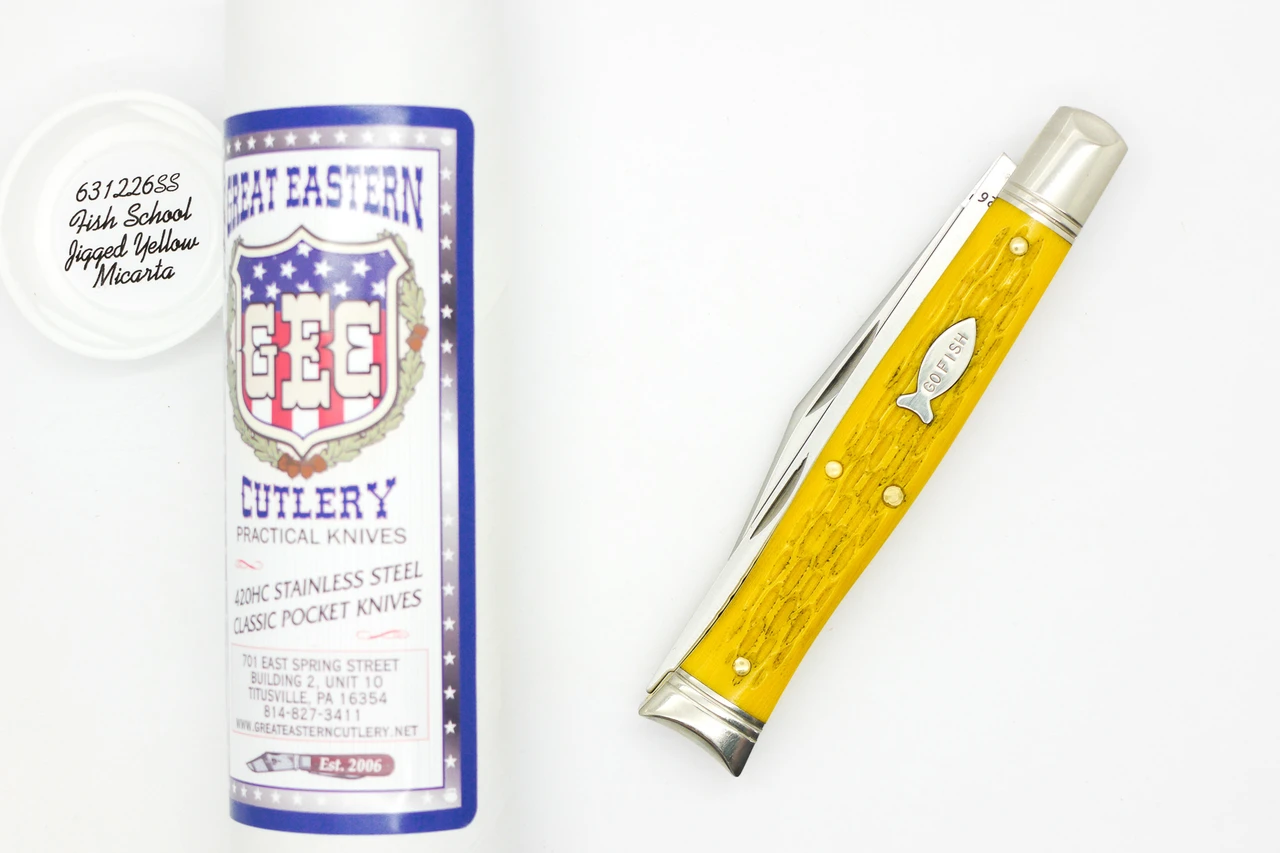
Another thing to love about the traditional pocket knife patterns produced by Great Eastern Cutlery is that they use high-quality knife scales and exhibit excellent fit and finish.
Commonly, traditional pocket knives were finished with antler or jigged bone scales. Many Great Eastern Cutlery knives still are, which gives them a polished, opulent and vintage aesthetic.
This they share in common with other makers of traditional pocket knives, like Case and Rough Ryder.
Things to Know About Great Eastern Cutlery Knives
While some of the top reasons that Great Eastern Cutlery Knives are covered here, it is also the case that since they are made with 1095 steel, there are some special notes you should observe to ensure that your knife is properly maintained, to protect both your investment and the performance of your knife.
For all its virtues, one big drawback of 1095 is that it will rust, and it will rust readily. You don’t even need to casually expose it to corrosive elements for this to happen.
Therefore, after every use, you should clean your knife, and before storing it (whether you used it or not) you should apply an appropriate oil to the blade. Mineral oil, knife oil, and gun oils will work fine here. Another is tsubaki oil, which is a food safe oil that will also protect your knife.
Also, as you use your knife, particularly as you expose it to acids, it will form what is called a patina. A patina is a sort of discoloration of the blade caused by “black rust” a type of iron oxide that actually forms a light layer on your blade that will help protect it from “red rust.”
A patina will not harm your steel, will in fact provide a modicum of insulation for it against rust, and on top of that, most users find it visually appealing, which is just one more reason that these knives represent not just quality but an heirloom investment.
Shop GEC Knives Here
Invest in Great Eastern Cutlery knives for your collection, or better yet, carry one of these throwback knives and see what you’ve been missing. It’s well worth the investment. Check out our full collection and if you have questions or are looking for something specific get in touch with us directly before you buy.